Can Machines Be Creative?
From "Parrots" to Problem Solvers.

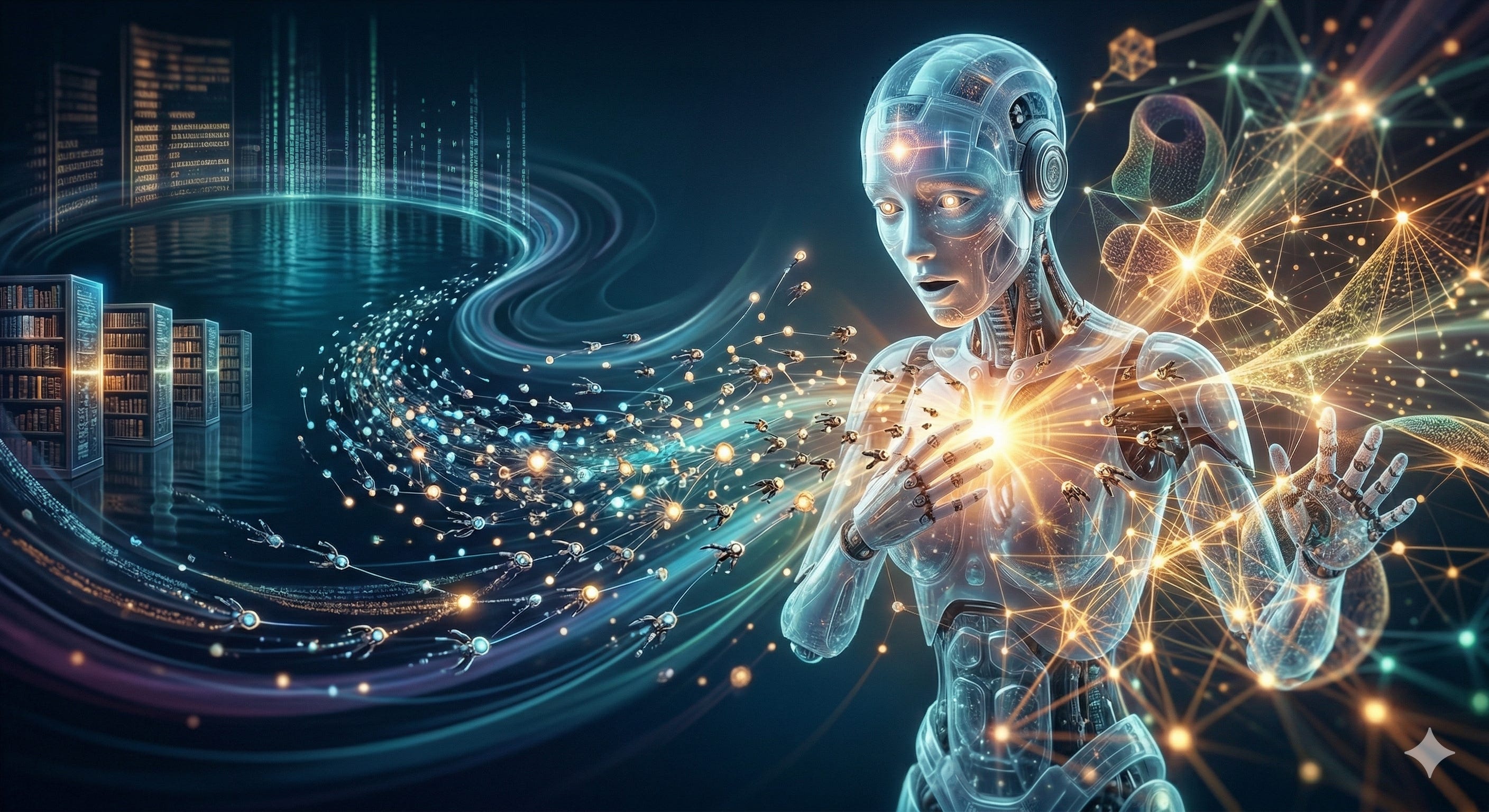
We have spent the last two years watching AI act like a super-powered encyclopedia. It’s great at recalling facts, but we are now entering a new era. We are moving away from models that “repeat” toward models that can “discover.”
In a recent talk at MIT (originally reported by Forbes), Markus Buehler, an MIT professor and AI expert, shared a fascinating look at where this is going.
The Power of the “Swarm”:
Instead of one giant AI trying to do everything, Buehler suggests the future lies in swarms. Think of these as groups of small AI agents working together, much like a team of humans.
He explains that creativity isn’t necessarily about how smart one single robot is. Instead, it’s about how these agents interact. When they collaborate, they can solve “tough problems” and come up with ideas that weren’t pre-programmed into them.
Three Steps of AI Evolution:
Buehler breaks down the history of AI into three simple stages:
Playback: Like a music box. It plays exactly what you put in.
Generation: Like a composer. It uses what it learned to create something familiar but new.
Discovery: This is the new frontier. This is where AI “writes its own score” to solve problems in the real world.
Is There a “Spark” in the Machine?
This leads to a big question: Is AI actually creative?
Buehler defines creativity as a system that changes itself based on what it creates. He uses a great analogy:
The Pond: Searching for truths we already know.
The River: Flowing forward to create entirely new worlds.
If AI can look at the world, realize it was wrong about something, and change its mind, it starts to look a lot like human thinking.
This shift is a bit “mind-boggling” because it touches on philosophy. If a machine can truly create something new, it means creativity might not be a “human-only” trait.
On the other hand, if AI is just following a complex pattern, it might suggest that human creativity is a pattern we just haven’t fully understood yet.
Either way, we are no longer just building better search engines. We are building systems that can think, explore, and perhaps even “imagine.” As we move forward, our job is to learn how to work alongside these creative swarms.
Source: Forbes.com