Insights from Anthropic's User Study: What 81,000 People want from AI
Global Perspectives on Artificial Intelligence.

As artificial intelligence continues to integrate into our daily lives, understanding public sentiment is becoming increasingly critical. Mainstream polls often capture broad trends, but they frequently miss the underlying reasons behind public opinion. To bridge this gap, Anthropic recently released what it describes as the largest-ever qualitative study on AI attitudes.
By leveraging their own technology, Anthropic interviewed 81,000 users across 159 countries to uncover their hopes, fears, and predictions for the future of artificial intelligence.
The Methodology: AI as a Research Tool
The scale and execution of this study are just as notable as its findings. In December, Anthropic introduced the Claude Interviewer. This specialized version of Claude was designed specifically to conduct open-ended conversations.
In a single week, this system successfully administered tens of thousands of in-depth interviews across 70 different languages. This achievement serves as a remarkably strong proof of concept for generative AI as a qualitative research tool, showcasing capabilities that did not exist a year ago.
Key Findings: Hopes versus Fears
The study provided a nuanced look at what users actually want from AI technology, as well as what keeps them up at night.
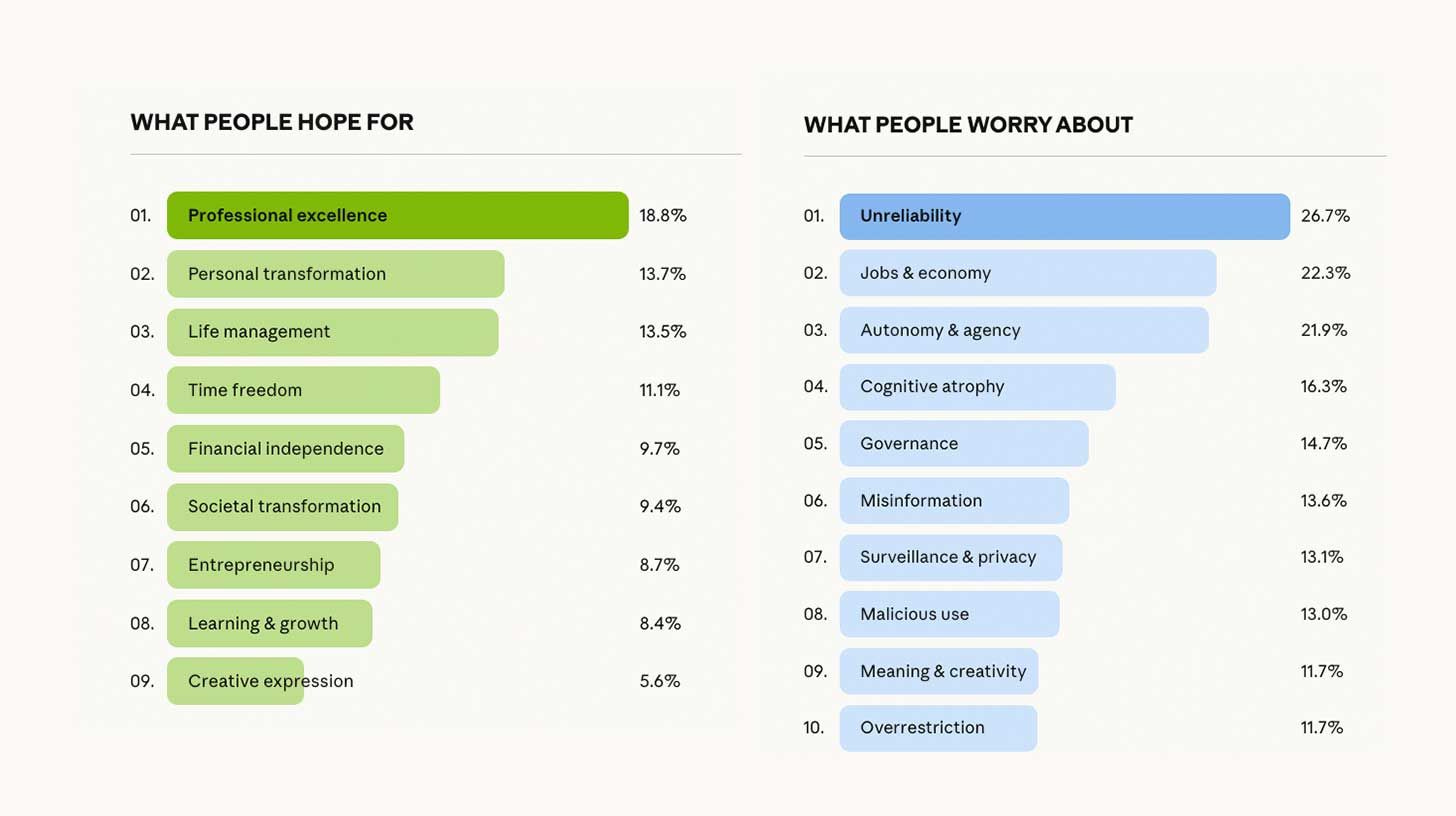
Greatest Hopes for AI:
Professional Excellence: This was the top-reported hope among users looking to enhance their career performance.
Time Management: Users frequently cited the desire to free up personal and professional time.
Financial Independence: Leveraging AI for economic gain and stability was a common theme.
Life Management: Respondents expressed a strong desire for AI to assist with broader daily organization.
Primary Concerns and Fears:
Accuracy: The fear of AI hallucinating or simply getting things wrong outranked every other concern.
Job Anxiety: Worries about automation replacing human roles remained a highly significant issue.
Loss of Agency: Users expressed anxiety over surrendering control to automated systems.
Over-reliance: There is a growing concern that society may become too dependent on AI assistance.
Regional Variances in AI Sentiment
The data also revealed that geography plays a major role in how people perceive artificial intelligence. Sentiment is far from uniform across the globe.
According to the Anthropic study, users in India and South America skewed above average in their optimism and favorability toward AI. Conversely, respondents in the United States, Europe, Japan, and South Korea demonstrated a more cautious approach, with sentiments running neutral or below average.
Why This Matters for the Tech Industry
While mainstream quantitative polls have recently shown cratering favorability numbers for AI, Anthropic’s qualitative approach adds essential nuance that those surface-level surveys miss. It shows that while users are deeply concerned about accuracy and job security, they are simultaneously eager to harness the technology for professional growth and personal efficiency.
Understanding these complex, sometimes contradictory feelings is essential for developers, educators, and policymakers as they guide the next phase of technological development.